Choosing the right hardware for your property is about more than just aesthetics; it is the fundamental barrier between your assets and potential intruders. When upgrading security for a commercial building or a high-end residence, property owners often find themselves debating between two primary options: the ubiquitous cylindrical deadbolt and the robust mortise lock.
While traditional deadbolts are standard in many residential settings due to their affordability and ease of installation, industry experts often lean toward mortise locks for heavy-duty applications. But does complexity equate to better protection? This article examines the mechanics, durability, and security features of both locking systems to help you decide which solution offers the peace of mind you deserve.
What is a traditional cylindrical deadbolt?
Before comparing security levels, it is helpful to understand the mechanics. A traditional cylindrical deadbolt is the lock found on the majority of American homes. It is installed by boring two circular holes into the door: one through the face of the door for the lock cylinder and thumb turn, and another through the edge for the bolt itself.
The primary advantage of this system is simplicity. It is relatively easy to install and replace. However, because the hardware sits primarily on the surface of the door, it can be vulnerable to brute-force attacks like kick-ins or hammering if not reinforced with a high-quality strike plate.
What makes a mortise lock different?
A mortise lock requires a rectangular pocket—or "mortise"—to be cut into the edge of the door itself. The entire lock body slides into this pocket. This design integrates the latch and the deadbolt into a single, heavy-duty metal box (the chassis).
This integration is a key differentiator. Because the lock mechanism is encased inside the door rather than sitting on the surface, it becomes an integral structural component of the entry point.
Comparison: Security and Structural Integrity
To answer the core question, we must look at how these locks behave under stress. In almost every metric regarding physical strength, the mortise lock holds an advantage.
1. Resistance to Forced Entry
A mortise deadbolt is generally thicker and longer than its cylindrical counterpart. Furthermore, the housing of a mortise lock adds structural reinforcement to the door. When an intruder attempts to kick in a door, a cylindrical lock relies heavily on the strength of the door frame and the mounting screws. A mortise lock, however, distributes the force across a larger area of the door edge, making it significantly more resistant to structural failure.
2. Durability and Lifecycle
Commercial spaces utilize mortise locks because they are engineered for high-frequency use. They contain heavier springs and more robust internal components capable of withstanding hundreds of thousands of cycles. A standard cylindrical deadbolt may wear out or become loose over time, creating a security gap known as "lock slop," which can make the bolt easier to manipulate.
3. Cylinder Options
Mortise locks are highly modular. They can accept a wide variety of high-security cylinders that resist picking, bumping, and drilling. While you can buy high-security cylinders for tubular deadbolts, the mortise platform offers a broader range of heavy-duty options.
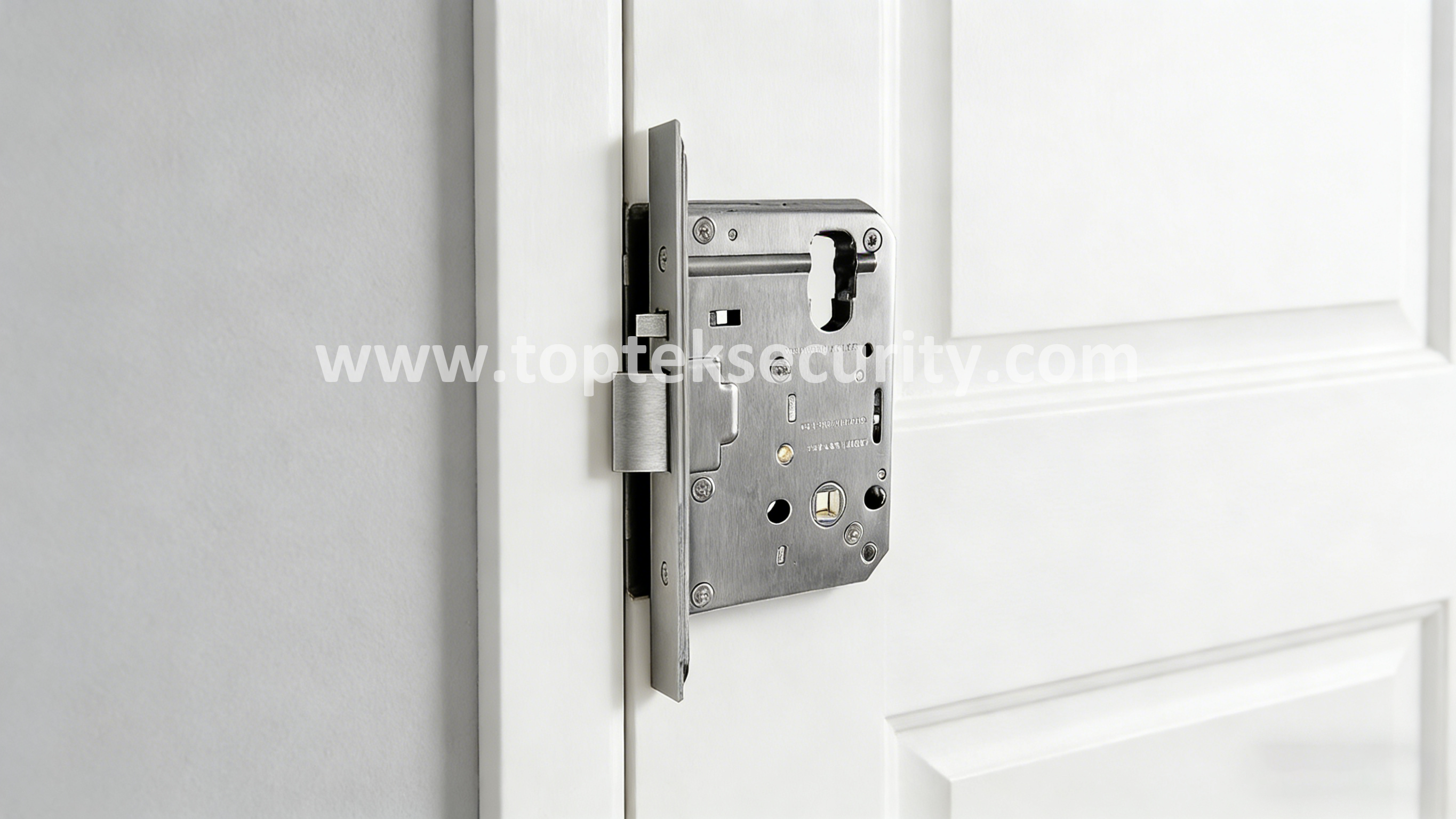
Feature Breakdown: Mortise vs. Cylindrical
To visualize the differences, refer to the comparison table below:
Feature | Traditional Cylindrical Deadbolt | Mortise Lock Set |
Installation | DIY-friendly; requires two standard drill holes. | Professional installation recommended; requires a mortised pocket. |
Door Weakness | Removing wood for the cross-bore can weaken the door structure slightly. | The lock body fills the cavity, often reinforcing the door. |
Functions | Usually limited to locking/unlocking. | Diverse functions: entry, classroom, storeroom, privacy, dormitory, etc. |
Aesthetics | Functional and standard. | High-end; offers a wide variety of ornate levers and trims. |
Price Point | Low to Medium. | Medium to High. |
Security Grade | Typically ANSI Grade 2 or 3 (Residential). | Typically ANSI Grade 1 (Commercial/High Security). |
Why choose a manufacturer like Zhongshan Toptek Security Technology Co., Ltd.?
When selecting high-security hardware, the manufacturing quality matters just as much as the lock type. You want a manufacturer that understands international safety standards and rigorous testing.
Zhongshan Toptek Security Technology Co., Ltd. has established itself as a leader in this space. With over 30 years of production experience since 1991, they specialize in both mechanical and electrified hardware solutions. Their expertise is particularly relevant for businesses looking for reliable mortise locks that meet strict safety codes.
Toptek operates a 15,000-square-meter factory with efficient automated production lines, ensuring precision in every lock case produced. Their commitment to quality is evidenced by their compliance with international standards, including CE, UL, and EN 1634 for fire-rated door locks. Whether you require a standard mortise deadbolt or a complex multi-point locking system, sourcing from a manufacturer with ISO 9001 and ISO 45001 certifications ensures that the hardware will perform when it matters most.
Are there downsides to mortise locks?
While mortise locks generally offer superior security, they are not the automatic choice for every situation.
Cost: The lock body itself is more expensive than a cylindrical lock, and the labor cost for installation is higher due to the woodworking precision required.
Door Compatibility: Not all residential doors are thick enough to accommodate a mortise pocket. You typically need a solid-core door with adequate thickness (often 1.75 inches or more).
Replacement: If you have a door pre-drilled for a cylindrical lock, switching to a mortise lock is difficult and usually requires a new door.
1
Frequently Asked Questions (FAQ)
Q: Can I install a mortise lock on a standard hollow-core residential door?
A: Generally, no. Hollow-core doors lack the internal material strength to support the heavy lock body of a mortise set. These locks are best suited for solid wood or steel doors.
Q: Is a mortise deadbolt different from a regular deadbolt?
A: Yes. A regular deadbolt is a standalone unit. A mortise deadbolt is integrated into the lock chassis. When you turn the key or thumb turn on a mortise lock, it throws the deadbolt from within the metal casing, offering smoother operation and greater stability.
Q: Does Zhongshan Toptek Security Technology Co., Ltd. offer custom solutions?
A: Yes, Toptek is known for exceptional OEM and ODM services. They provide technical support and consulting to help customers develop tailored solutions, whether for airports, office buildings, or public places.
Which lock is right for you?
If your priority is securing a high-traffic commercial building, a luxury home, or a property that requires the highest grade of physical security, the mortise lock is the clear winner. Its resistance to forced entry, combined with the ability to integrate specialized functions, makes it superior to the traditional cylindrical deadbolt.
However, for standard residential back doors or budget-conscious renovations, a high-quality cylindrical deadbolt combined with a reinforced strike plate remains a respectable choice.
Security is an investment. By understanding the mechanical advantages of mortise systems and partnering with established manufacturers like Zhongshan Toptek Security Technology Co., Ltd., you ensure that your property remains safe, secure, and accessible only to those with the right key.
Mortise Locks
mortise deadbolt
replacing a mortise lock

 English
 العربية
 Français
 Русский
 Español
 Português
 Deutsch
 italiano
 日本語
日本語 한국어
한국어 Nederlands
 Tiếng Việt
 ไทย
ไทย Polski
 Türkçe
 አማርኛ
አማርኛ ພາສາລາວ
 ភាសាខ្មែរ
 Bahasa Melayu
 ဗမာစာ
ဗမာစာ தமிழ்
தமிழ் Filipino
 Bahasa Indonesia
 magyar
 Română
 Čeština
 Монгол
 қазақ
қазақ Српски
 हिन्दी
 فارسی
فارسی Kiswahili
 Slovenčina
 Slovenščina
 Norsk
Norsk Svenska
 українська
 Ελληνικά
 Suomi
Suomi Հայերեն
 עברית
עברית Latine
 Dansk
Dansk اردو
اردو Shqip
Shqip বাংলা
বাংলা Hrvatski
 Afrikaans
 Gaeilge
 Eesti keel
 Māori
Māori සිංහල
සිංහල नेपाली
 Oʻzbekcha
 latviešu
 অসমীয়া
 Aymara
 Azərbaycan dili
 Bamanankan
 Euskara
 Беларуская мова
 भोजपुरी
 Bosanski
 Български
 Català
 Cebuano
 Corsu
Corsu ދިވެހި
 डोग्रिड ने दी
 Esperanto
 Eʋegbe
 Frysk
Frysk Galego
 ქართული
 guarani
 ગુજરાતી
 Kreyòl ayisyen
 Hausa
Hausa ʻŌlelo Hawaiʻi
 Hmoob
Hmoob íslenska
 Igbo
Igbo Ilocano
 Basa Jawa
 ಕನ್ನಡ
ಕನ್ನಡ Kinyarwanda
 गोंगेन हें नांव
 Krio we dɛn kɔl Krio
 Kurdî
Kurdî Kurdî
Kurdî Кыргызча
 Lingala
 Lietuvių
 Oluganda
 Lëtzebuergesch
 Македонски
 मैथिली
 Malagasy
 മലയാളം
 Malti
Malti मराठी
मराठी ꯃꯦꯇꯥꯏ (ꯃꯅꯤꯄꯨꯔꯤ) ꯴.
 Mizo tawng
 Chichewa
 ଓଡ଼ିଆ
ଓଡ଼ିଆ Afaan Oromoo
 پښتو
پښتو ਪੰਜਾਬੀ
 Runasimi
 Gagana Samoa
 संस्कृत
 Gaelo Albannach
 Sepeti
 Sesotho
 chiShona
 سنڌي
سنڌي Soomaali
 Basa Sunda
 Wikang Tagalog
 Тоҷикӣ
 Татарча
 తెలుగు
 ትግንያውያን
 Xitsonga
 Türkmençe
 संस्कृत
 ئۇيغۇرچە
 Cymraeg
 isiXhosa
 ייִדיש
 Yorùbá
 isiZulu